
The craft
How to judge a rug
Four things separate a rug that lasts a century from one that looks similar and does not. All four can be checked in a shop, by you, without expertise or equipment.
One · Construction
Turn it over. That is the whole test
On a hand-knotted rug the knots are the image, so the design reads from the back at the same resolution as the front. Nothing else is true of a machine-made or tufted rug, and no amount of sales talk survives thirty seconds of looking.
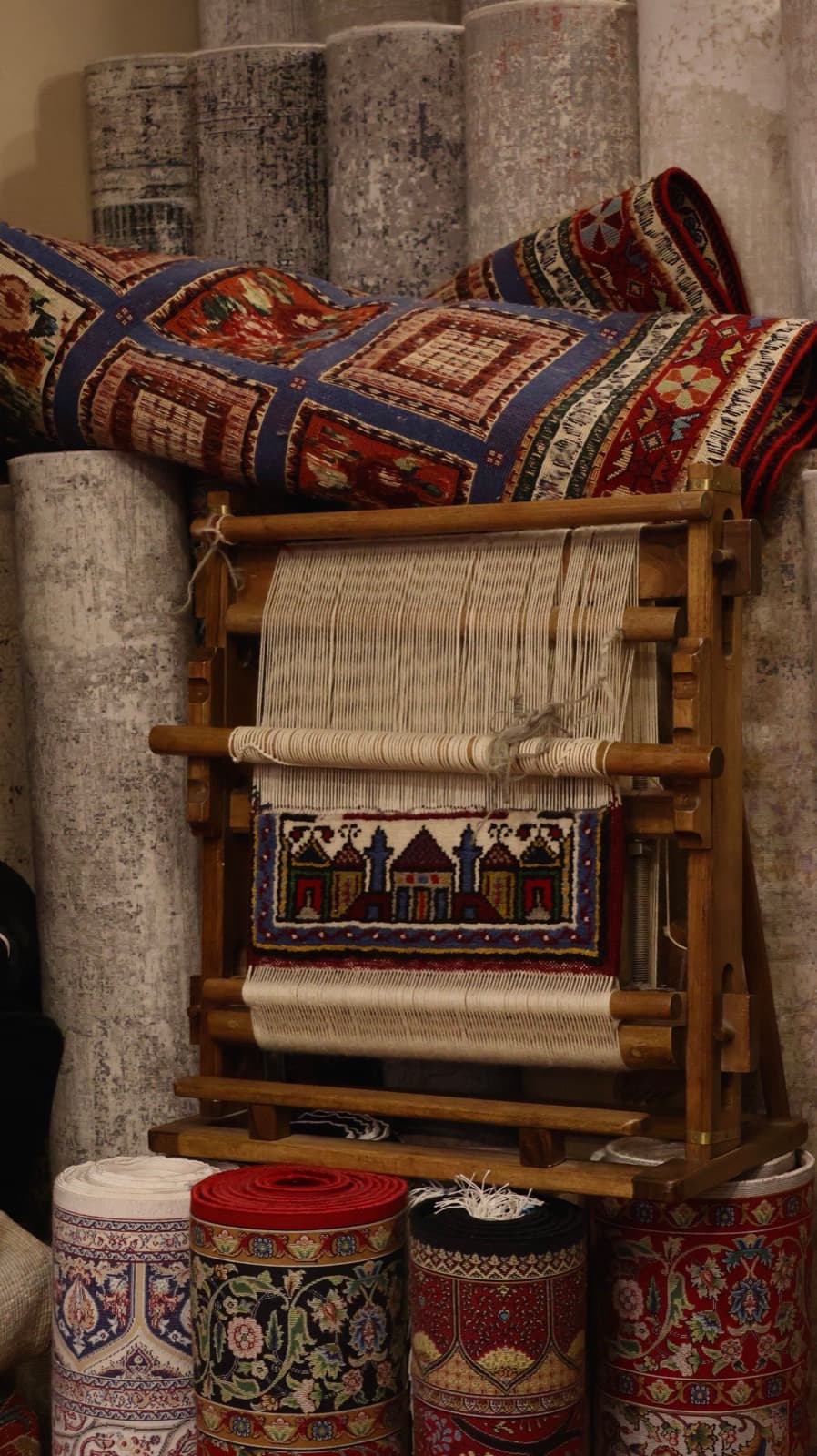
A rug is built on a loom like the one here: warps strung vertically under tension, and every knot tied by hand around a pair of them, row by row, for months.
What we sell
Hand-knotted
The design is as legible from the back as the front, at the same resolution, because the knots are the image. Slight irregularity everywhere — rows wander, knots vary. The fringe is the warp itself, emerging from the body.
Two · Knot density
Resolution, not quality
Knots per square inch measures how much detail a design can hold. Below is one motif at three densities — the same size of rug, the same three centimetres across. Watch what happens to the curve.
60 KPSI
Village and tribal weaving. Bold, geometric, deliberately coarse — and the pile is deeper and springier for it.
300 KPSI
The workshop standard. Fine enough to draw a curve, robust enough to live on a floor for a century.
900 KPSI
Silk, and years of one person's life. At this density the weave stops being visible at all and the design behaves like paint.
Doubling the knots roughly quadruples the time at the loom, and time at the loom is what you are paying for. But a high count is not a mark of quality on its own — a Moroccan Beni Ourain at 60 knots is doing something no 900-knot silk can, and weaving it finer would make it worse. Ask what the design needs, then check the weave allows it.
Three · Anatomy
A rug is three things at once
A foundation held under tension, a pile knotted onto it, and edges that stop the whole thing coming apart. Select a part to see where it sits.
The knot
A short length of wool or silk looped around two warps and pulled down. Persian (asymmetric) knots wrap one warp fully and hook the other, which suits fine curvilinear drawing. Turkish (symmetric) knots wrap both evenly and give a hardier pile. Neither is better — they are suited to different designs.
Four · Materials
The number nobody prints on the label
Hand-spun wool
The best pile there is
Spun by hand from a high-altitude sheep, with the lanolin left in. It feels faintly waxy, springs back when pressed, and gets better with use because the lanolin keeps working. It will outlast machine-spun wool at twice the knot count — which is why wool quality, not knot count, is the number nobody prints on a label.
Machine-spun wool
Even, and a little lifeless
Uniform thickness, consistent colour, cheaper. Perfectly serviceable, and it takes dye evenly — which is precisely why it lacks the faint shifting depth of a hand-spun pile.
Silk
For light, not for floors
Takes far finer knots and catches light so that the colour changes as you walk around it. It is also weaker underfoot than wool. A pure silk rug belongs on a wall, in a bedroom, or anywhere it will be looked at more than walked on.
Cotton foundation
What holds it all together
Most warps and wefts are cotton: it is strong, stable and does not stretch, so the rug keeps its shape. A wool foundation gives a suppler, lighter rug, which is why nomadic weaving uses it — nobody carries a cotton loom across a mountain.
And the colour
Good dye fades towards a colour, not away from one
Madder root gives every red from brick to rose. Indigo gives blue, and over a yellow of weld or vine leaf, green. Walnut husk and oak gall give the browns. All of them fade — but they fade towards a related colour, which is why a hundred-year-old rug looks harmonious rather than washed out.
Look for abrash: faint bands of slightly different tone across the field, where one dye lot ran out and the next was not quite identical. Dealers once tried to hide it. It is the signature of hand-dyed wool, and a rug with none at all invites the question of what it was dyed with.
Modern chrome dyes are genuinely lightfast — the disaster of the 1880s, when aniline dyes turned a generation of rugs grey and brown, is not being repeated. But they hold their colour flatly. Natural dye shifts with the angle of the light, because the fibre took it unevenly.
Now go and look at one
Every rug we hold lists its knot count and its materials — and you can magnify any of them until the individual knots are visible, and count them yourself.